
Copper Water Bottles and Sustainable Living: Can Traditional Materials Have a Modern Role?
By TrueAyurvedaLife Editorial Team ·
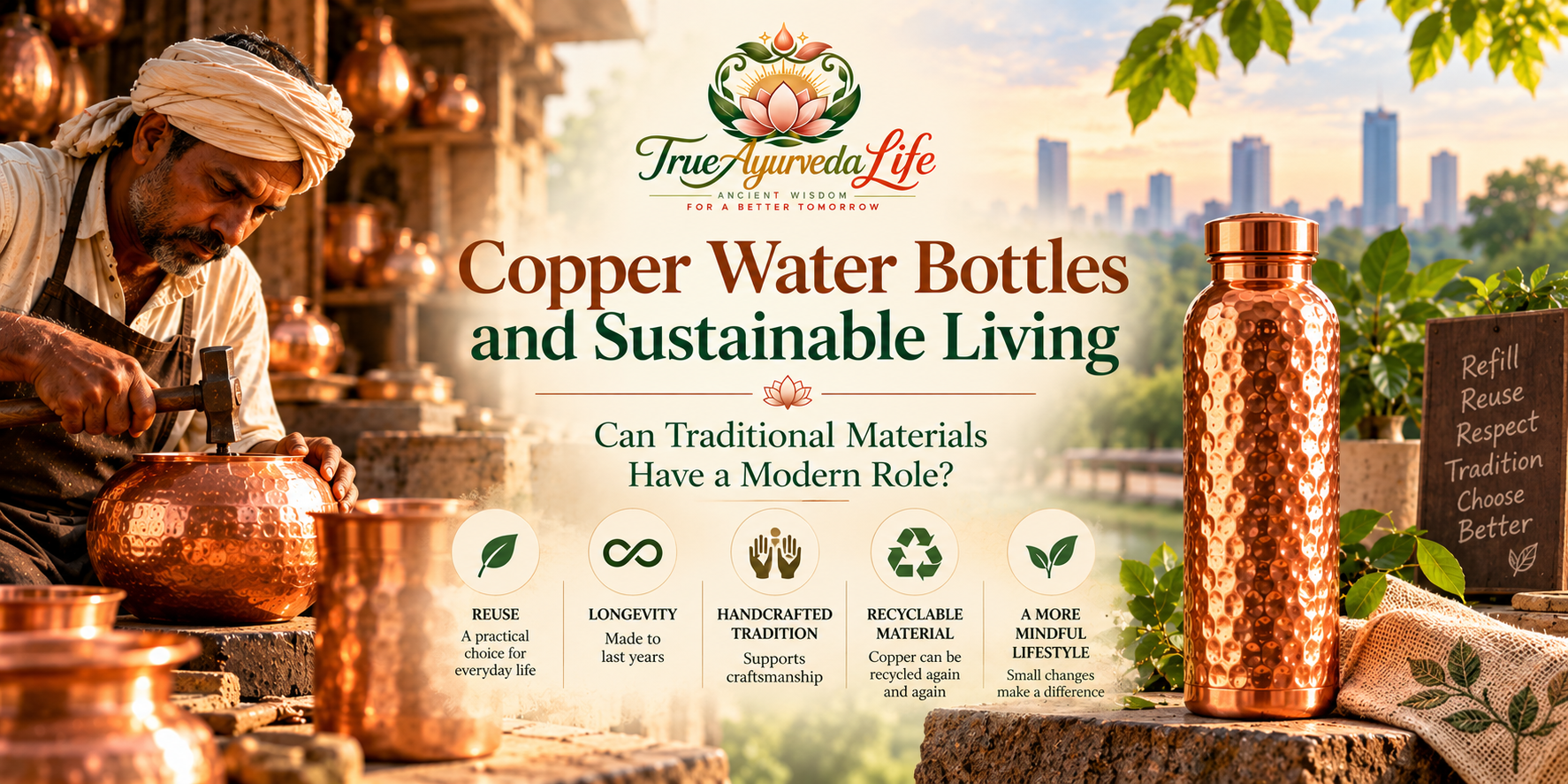
Sustainable living does not always begin with a dramatic lifestyle change. Sometimes, it starts with the everyday objects we choose to buy, keep, and use for years.
A water bottle is a simple example. It accompanies us to work, on journeys, during exercise, and through our daily routines. Yet the material it is made from, its expected lifespan, and whether we reuse it regularly can all influence its environmental footprint.
Copper has a long history in Indian households, from traditional water vessels to handcrafted drinkware. Today, copper water bottles bring that familiar material into modern life. But can a traditional copper bottle genuinely fit into a more sustainable lifestyle?
The answer depends on looking beyond appearance and considering durability, responsible production, reuse, craftsmanship, and recycling.
1. Sustainable Living Begins With Everyday Choices
Sustainability is often associated with major decisions such as changing how we travel, reducing household energy use, or choosing renewable resources. However, everyday purchasing habits also matter.
Consider how often we buy products that are inexpensive but short-lived. A bottle may be replaced because it cracks, loses its finish, develops a faulty lid, or simply falls out of fashion. Over time, repeated replacement means more materials, manufacturing, packaging, and transportation.
A reusable water bottle offers a different approach. Instead of regularly purchasing disposable bottles, we can carry one reliable bottle and refill it with safe drinking water.
The important principle is not simply choosing a particular material. It is choosing an item that suits our needs, using it consistently, maintaining it properly, and avoiding unnecessary replacement.
2. What Makes Copper an Interesting Material?
Copper has been used in tools, vessels, household objects, architecture, and decorative crafts across many cultures. In India, it also has a familiar place in traditional household practices.
One of copper's notable material properties is its recyclability. Copper can be recycled repeatedly without losing its essential physical and chemical properties. Recycled copper can re-enter manufacturing and serve many of the same purposes as newly mined copper. The International Copper Association explains that recycling helps conserve resources and reduces the energy required compared with primary production.
This gives copper a potential role in a circular economy, where materials remain useful for as long as possible rather than being discarded after a short period.
Learn about copper's life cycle and recycling https://internationalcopper.org/sustainable-copper/about-copper/copper-life-cycle/
However, recyclability alone does not automatically make every copper product sustainable. Mining, refining, manufacturing, finishing, packaging, and transportation all have environmental impacts. A responsible assessment considers the entire journey of the product, not just the material's properties.
3. Reuse Matters More Than Buying Something New
One of the simplest ways to make a water bottle choice more sustainable is to use the bottle you already own for as long as it remains suitable and safe.
If you need a new bottle, think about how often you will use it. A reusable bottle that accompanies you every day has a different purpose from one that stays in a cupboard.
Research using life-cycle assessment has shown why the number of uses matters when comparing reusable and single-use drinking bottles. A 2026 study found that, in its modelled scenarios, the production impact of reusable bottles became much less significant when considered across a year of use, while repeated single-use bottle consumption increased the overall impact. Results also depended on cleaning practices and the materials compared. Read the study on refillable bottles and life-cycle impacts https://pubmed.ncbi.nlm.nih.gov/41175910/ .
This research did not establish that copper bottles are always better than every alternative. Instead, it highlights a broader lesson: the environmental value of a reusable product depends partly on how frequently and how long it is actually reused.
For everyday hydration, carrying a bottle, refilling it, and taking care of it are practical habits that can reduce reliance on single-use packaging.
4. Traditional Craftsmanship and Thoughtful Consumption
A handcrafted copper bottle can offer more than a functional way to carry water. Its finish, shape, and small variations may reflect the skills involved in working with metal.
Traditional metalworking often involves several stages, including shaping, hammering, joining, finishing, and checking the final object. These processes take time and skill. In some cases, purchasing a well-made product also helps sustain the livelihoods of craftspeople and small manufacturing businesses.
But handmade does not automatically mean environmentally friendly. The environmental impact still depends on the materials used, production methods, energy consumption, transport, and product lifespan.
The more useful question is whether the bottle is made thoughtfully, performs its intended function, and is likely to remain part of your daily routine for years.
To explore this cultural connection further, read our article on Why copper remains part of Indian craftsmanship https://trueayurvedalife.com/blog/copper-indian-craftsmanship .
5. Can a Copper Water Bottle Replace Single-Use Bottles?
For people who regularly buy bottled water while travelling or working outside the home, carrying a reusable bottle can be a practical alternative where safe refill water is available.
A copper bottle can serve this purpose, provided it is designed for drinking water and maintained according to the manufacturer's instructions.
There are a few useful considerations:
Choose for regular use: Select a capacity and shape that fit your daily routine.
Check construction: Look for clear information about the material, lid, joints, and any internal lining.
Carry safe drinking water: A reusable bottle is not a substitute for a reliable source of potable water.
Clean it appropriately: Follow the manufacturer's care guidance and allow the bottle to dry properly.
Avoid unnecessary replacement: Do not buy another bottle simply because a new design becomes fashionable.
Also, copper is not the only valid reusable option. Stainless steel, glass, and other suitable materials can all serve different needs. The right choice is the one you will use consistently and care for properly.
6. The Importance of Responsible Copper Production
Copper is valuable and recyclable, but extracting and processing new copper requires resources and energy. Mining and refining can also affect land, water, and surrounding ecosystems when not managed responsibly.
This is why sustainability should include questions about sourcing and manufacturing, rather than focusing only on the finished bottle.
When evaluating a copper water bottle, look for transparent product information. Does the seller clearly describe the material? Are manufacturing and care details available? Is the construction suitable for its intended use? Does the business avoid unsupported environmental claims?
If a seller provides credible information about recycled content, responsible sourcing, or manufacturing practices, those details can help inform your decision. Do not assume that a product contains recycled copper simply because copper is recyclable.
For brands, greater transparency is an important step towards helping customers make informed choices.
7. Copper, Longevity, and the Circular Economy
A circular economy aims to keep materials and products in use for as long as practical. Repair, reuse, responsible manufacturing, and recycling all contribute to this approach.
Copper is particularly relevant because it can be recycled without losing its essential properties. However, recycling still requires collection, sorting, processing, and energy. A bottle must also be made in a way that allows its materials to be recovered effectively.
For consumers, the practical steps are straightforward:
Buy a suitable product rather than choosing solely on impulse.
Maintain it according to its care instructions.
Replace individual components when practical and safe, rather than discarding the whole item.
When the bottle can no longer be used, investigate local metal recycling or scrap collection options.
These actions help extend the useful life of the product and improve the chances that its material will remain in circulation.
8. Bringing Traditional Materials Into Modern Life
Traditional materials do not need to be treated as relics of the past. They can continue to serve useful purposes when their design, production, and everyday use respond to modern needs.
Copper drinkware illustrates this connection. Its familiar place in Indian household traditions, distinctive appearance, and potential for long-term use make it relevant to people who appreciate heritage as well as practical design.
Still, sustainability is not guaranteed by tradition, appearance, or material alone. A product's real contribution depends on responsible production, repeated use, appropriate maintenance, and end-of-life recovery.
Our article, <Link url="https://trueayurvedalife.com/blog/story-of-copper-water-bottle" title="From Tamba to Today: The Story of the Copper Water Bottle"/>, explores how this traditional object has found a place in contemporary life.
A More Thoughtful Way to Hydrate
Sustainable living is rarely about finding one perfect product. It is about making considered choices and using resources thoughtfully.
A copper water bottle can be part of that approach when it is well made, used regularly, cared for properly, and kept in service for as long as practical. Its recyclability offers another advantage, although the environmental impact of production should not be overlooked.
At TrueAyurvedaLife, we believe traditional materials can have a meaningful place in modern everyday living when craftsmanship, usefulness, and thoughtful consumption come together.
Sometimes, a more considered lifestyle begins with something as ordinary as the bottle we choose to carry—and how well we use it.