
Copper Tongue Scraper: Benefits, How to Use It & Copper vs. Stainless Steel
By True Ayurveda Life Editorial Team ·
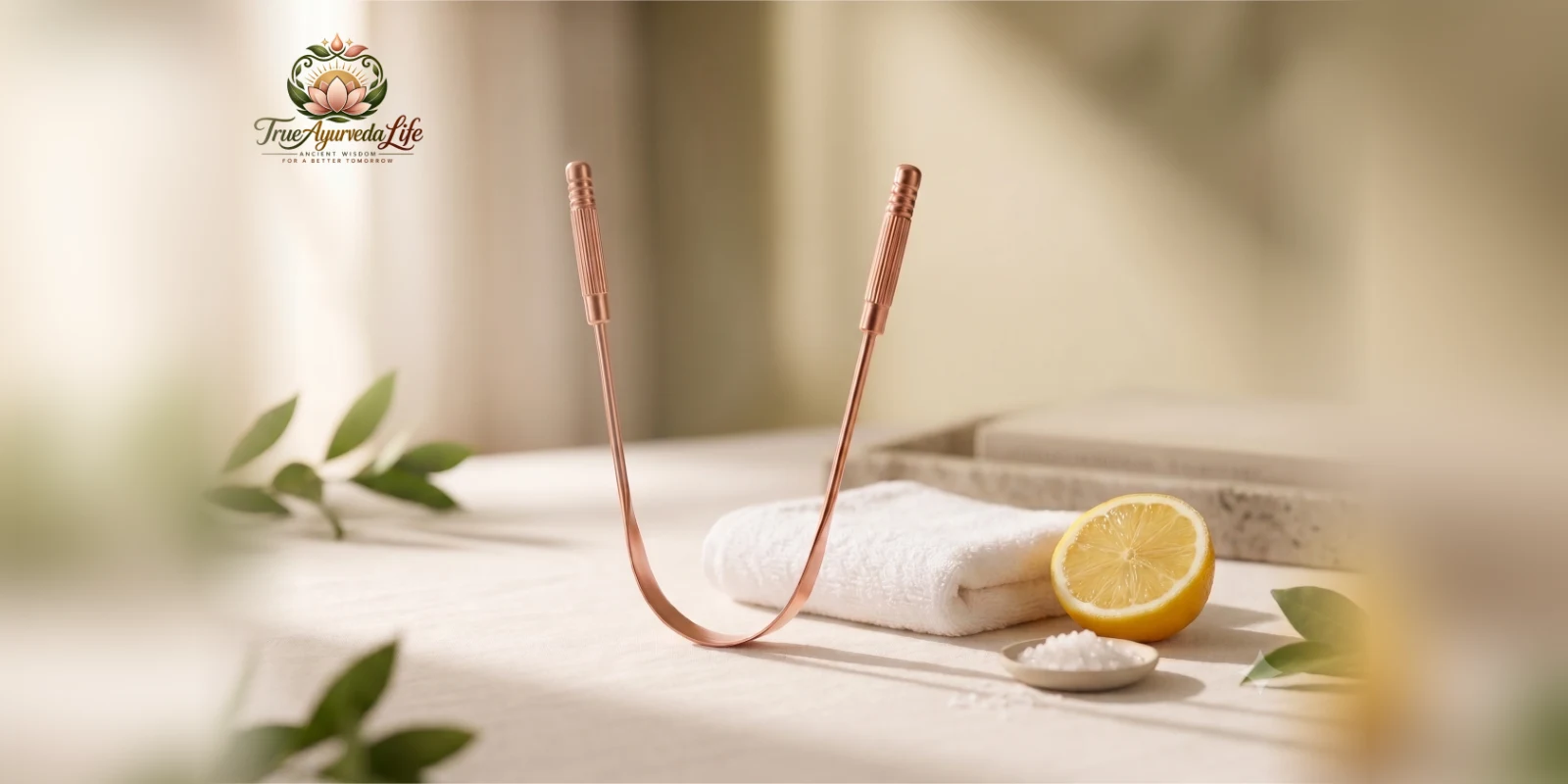
A copper tongue scraper is a thin, U-shaped tool made of pure copper that you gently pull across your tongue each morning to remove the whitish coating of bacteria, food debris and dead cells that builds up overnight. Used once a day, it takes about a minute, creates no plastic waste, and works as a simple complement to brushing and flossing — not a replacement for them, or for regular dental checkups.
Tongue scraping is one of the oldest oral-hygiene habits in the world, and it has recently found a new audience in the United States as more people look for low-waste, low-tech wellness routines. If you're wondering what a copper tongue scraper actually does, whether it's better than stainless steel or plastic, and how to use one without gagging or hurting yourself, this guide answers all of it in plain language — including the parts that are backed by evidence and the parts that are tradition only.
Last updated: September 2026 · Written by the True Ayurveda Life editorial team · For general information only — this is not medical or dental advice.
Key Takeaways
- What it does: physically removes the coating on the surface of your tongue, which is made up of bacteria, dead cells, mucus and food particles.
- Best-supported benefit: a cleaner-feeling mouth and less tongue coating, which is a common source of morning bad breath.
- How often: once a day, first thing in the morning, with light pressure and 4–5 gentle passes.
- Copper vs. steel: both work mechanically. Copper adds the traditional Ayurvedic material and natural antimicrobial properties; stainless steel is lower-maintenance and never tarnishes.
- What to avoid: pressing hard, reaching too far back, skipping the rinse between passes, and using the dishwasher or bleach to clean it.
- What it isn't: a cure for any medical condition, a "detox," or a substitute for brushing, flossing and dental visits.
In This Guide
- What is a copper tongue scraper?
- Why scrape your tongue at all?
- The Ayurvedic tradition of tongue scraping
- Copper tongue scraper benefits: tradition vs. evidence
- How to use a copper tongue scraper, step by step
- How often, and before or after brushing?
- Copper vs. stainless steel vs. plastic
- How to choose a good copper tongue scraper
- How to clean and care for it
- Who should be careful
- Common mistakes
- Myths vs. facts
- Building a simple Ayurvedic morning routine
- Frequently asked questions
What Is a Copper Tongue Scraper?
A tongue scraper — also called a tongue cleaner — is a smooth, rounded-edge tool designed to sweep the surface of the tongue in one direction, from back to front. Unlike a toothbrush, which pushes debris around with bristles, a scraper lifts the coating off with a single pass and leaves it on the tool, where you rinse it away.
A copper tongue scraper is simply a scraper made from copper instead of plastic or stainless steel. The classic design is a flexible U-shaped strip with a handle at each end: you hold both handles, place the curved edge on your tongue, and draw it forward. Because the strip is thin and springy, it follows the natural curve of the tongue rather than fighting it.
Not every "copper" scraper is the same. A genuine pure copper scraper is made from solid copper (ours is 99.9% pure and uncoated), while cheaper alternatives may be copper-plated or lacquered. That distinction matters for the same reason it does with water bottles — we explain it in detail in our guide to 100% copper vs. copper-plated products.
Why Scrape Your Tongue at All?
What is the coating on your tongue?
The top surface of your tongue is covered in thousands of tiny projections called papillae. They give the tongue its rough texture — and they also make it an excellent hiding place. Overnight, while saliva flow drops, bacteria, shed cells, mucus and food particles settle into the gaps between papillae and form a film. That film is the whitish or yellowish "coating" you see when you look at your tongue in the morning.
Why it matters for breath and taste
The large majority of bad breath (halitosis) starts in the mouth rather than the stomach, and the back of the tongue is one of the biggest contributors. Bacteria living in the coating break down proteins and release volatile sulfur compounds — the gases responsible for that unmistakable "morning breath" smell. Removing the coating physically removes a large share of those bacteria and their food supply. Many people also report that foods taste a little brighter after scraping, although this is subjective and hasn't been measured as rigorously as breath odor.
What the science does — and doesn't — say
Dental research generally supports mechanical tongue cleaning as a way to reduce tongue coating and breath-related compounds, and some studies suggest a scraper removes more coating than a toothbrush does. The effect, however, is usually modest, study quality varies, and the results don't last beyond the next time bacteria regrow — which is why it's a daily habit rather than a one-off fix. Mainstream dental guidance, including from the American Dental Association, treats tongue cleaning as a worthwhile part of a complete routine alongside brushing twice a day, cleaning between teeth, and seeing a dentist regularly.
Just as important: bad breath can also come from gum disease, cavities, dry mouth, tonsil stones, smoking, certain medications, and conditions outside the mouth. If scraping doesn't help, that's a reason to see a dentist, not to scrape harder.
The Ayurvedic Tradition of Tongue Scraping
In Ayurveda — India's traditional system of health — tongue scraping is called jihwa nirlekhana (Sanskrit for "scraping the tongue") and is one of the standard steps of dinacharya, the recommended daily routine. Classical Ayurvedic texts such as the Charaka Samhita and the Ashtanga Hridaya list tongue cleaning among the morning hygiene practices, alongside cleaning the teeth and rinsing the mouth, and traditional accounts mention scrapers made from metals including copper.
Ayurveda explains the practice through the idea of ama — a sticky residue that is said to accumulate overnight as the body rests and digests. The whitish tongue coating is viewed as a visible sign of it, and scraping it away in the morning is considered a way of starting the day with a "clean slate." Some traditional sources also link a clean tongue with a sharper sense of taste and better appetite.
It's worth being clear about what this is: a traditional framework, not a modern medical explanation. Concepts like ama aren't measured or recognized in Western medicine. You don't have to subscribe to the Ayurvedic theory to benefit from the practical, well-understood part — removing the bacterial film from your tongue. For readers who want the wider context of these habits, our guide to five Ayurvedic morning rituals shows where tongue scraping fits.
Why copper?
Tamra — copper — has been used in Indian households for centuries for vessels, utensils and cleaning tools. Traditional practice favors copper for two reasons: it's a durable, smooth metal that can be shaped into a thin, flexible scraper, and it has natural antimicrobial properties. The same reasoning sits behind the Ayurvedic practice of storing drinking water in copper, which we cover in our Ayurveda copper water ritual guide.
Copper Tongue Scraper Benefits: Tradition vs. Evidence
Product pages and social media posts often make sweeping claims about tongue scrapers. Here's a more careful breakdown of what a copper tongue scraper can reasonably be expected to do, and how strong the support is for each claim.
| Claimed benefit | Support | What to know |
|---|---|---|
| Removes tongue coating | Strong — it's mechanical | You can see the film on the scraper after each pass. |
| Fresher breath in the morning | Moderate — supported by dental research | Helps when the tongue is the source; won't fix gum disease or cavities. |
| Cleaner-feeling mouth, better taste | Anecdotal but widely reported | Subjective; many users notice it within days. |
| Natural antimicrobial material | Established for copper surfaces | Applies to the metal itself; it doesn't mean the scraper treats infections. |
| Plastic-free, reusable | Factual | A single pure copper scraper can replace years of disposable or plastic ones. |
| Supports digestion or "detox" | Traditional belief only | Not established by modern research — treat as a cultural association. |
1. A cleaner tongue and fresher morning breath
This is the benefit with the most practical support. By removing the overnight film, you remove the bacteria and the material they feed on, which reduces the compounds that cause morning breath. Most people notice the difference in how their mouth feels within the first week of daily use.
2. Copper's natural antimicrobial properties
Copper has a well-documented "oligodynamic" effect: tiny amounts of copper ions can disrupt microbes on contact. The best-known real-world example is the U.S. Environmental Protection Agency's 2008 registration of certain copper alloys as antimicrobial materials for touch surfaces, after testing showed they can kill more than 99.9% of specific bacteria within two hours when kept clean. That finding is about hard surfaces — it doesn't mean a copper scraper treats any oral condition — but it does support the long-standing reason copper is preferred for tools that spend time in the mouth and then sit on a bathroom counter.
3. A reusable, plastic-free habit
A plastic scraper typically softens, scratches or cracks after months of use and gets thrown away. A pure copper scraper is a single piece of metal with no coating to peel, and it can last for years with basic care. For anyone trying to cut down on bathroom plastic, that's a small but genuine gain.
4. A consistent, mindful morning cue
Habits stick when they're attached to a clear trigger. Scraping your tongue right after you wake up — before you drink, eat or brush — gives you a short, calm start to the day. Many people pair it with a glass of water and a few slow breaths, which is exactly how it's used in the traditional Ayurvedic routine.
What a copper tongue scraper can't do
It won't cure a medical condition, "detoxify" your organs, replace brushing or flossing, or fix bad breath caused by problems elsewhere. Anyone promising those results is overstating the case. Think of it as a very good, very cheap, low-waste hygiene tool — nothing more, and nothing less.
How to Use a Copper Tongue Scraper, Step by Step
Technique matters far more than force. A good session takes about 30 to 60 seconds.
- Use it first thing in the morning. Do it right after waking, before you eat, drink or brush your teeth. This is when the coating is thickest.
- Hold the handles. Grip one handle in each hand (or both in one hand) so the U-shaped strip is taut and the curved edge faces away from you.
- Stick your tongue out — relaxed, not strained. Breathe out slowly; it helps keep the gag reflex quiet.
- Place the curved edge at the back. Start as far back as is comfortable, roughly two-thirds of the way toward the throat. You don't need to go deeper than that.
- Pull forward in one smooth motion. Apply light pressure and draw the scraper toward the tip of your tongue. Don't drag it back and forth.
- Rinse the scraper after every pass. Run it under water so you're never reapplying what you just removed.
- Repeat 4–5 times. Cover the center first, then the left and right sides.
- Rinse your mouth, then brush as usual. Finish with a sip of water, then brush and floss.
- Wash and dry the scraper. Rinse it in warm water and dry it completely before putting it away.
Quick reference
| Question | Short answer |
|---|---|
| When? | Morning, on waking, before eating or drinking |
| How many passes? | 4–5, rinsing the scraper each time |
| How long? | About 30–60 seconds |
| How much pressure? | Light — the tongue shouldn't be sore or raw afterward |
| Direction? | Always back to front |
| How often? | Once a day |
How to avoid gagging
If you gag, you're almost certainly starting too far back or going too fast. Begin nearer the middle of the tongue for the first week, keep your breathing slow, and move a few millimeters farther back each day. Doing it before breakfast, when the stomach is empty, also makes most people more comfortable.
How Often Should You Scrape Your Tongue — and Before or After Brushing?
Once a day is enough for most people. The morning is the best time because the coating has had all night to build up. Some people add a second session in the evening; that's fine, but there's no evidence that doing it more often gives extra benefit, and over-scraping can irritate the tongue.
Before or after brushing? The Ayurvedic tradition scrapes first, then brushes, so that you brush your teeth without pushing the loosened film back around your mouth. Dental professionals generally say the order isn't critical — the important thing is that you actually do both, every day. If you're unsure, scrape first, rinse, then brush.
Copper vs. Stainless Steel vs. Plastic Tongue Scrapers
Any smooth, well-made scraper will remove tongue coating. The real differences are in material, maintenance, feel and sustainability. Here's an honest comparison.
| Factor | Copper | Stainless steel | Plastic |
|---|---|---|---|
| Removes tongue coating | Yes | Yes | Yes, but softer edge is less effective for some people |
| Antimicrobial material | Naturally antimicrobial | Neutral | None |
| Traditional Ayurvedic material | Yes | Sometimes | No |
| Durability | Long-lasting; can be bent back into shape | Very long-lasting | Wears, scratches and cracks over time |
| Maintenance | Occasional cleaning to remove tarnish | Very low; usually dishwasher-safe | Very low |
| Appearance over time | Develops a natural patina | Stays uniform | Can discolor |
| Plastic-free | Yes | Yes | No |
| Best for | Ayurvedic routines, anyone who values tradition and craftsmanship | Low-maintenance daily use | Budget or first-time use |
So, is copper better than stainless steel?
Not in the sense of cleaning more effectively — both do the same mechanical job. Copper's advantages are its traditional role in Ayurveda, its natural antimicrobial properties, and the way a well-made copper scraper flexes comfortably against the tongue. Stainless steel's advantages are that it never tarnishes and needs almost no upkeep. If you value the ritual and don't mind wiping the scraper dry and giving it an occasional lemon-and-salt clean, copper is a lovely choice. If you want the lowest-maintenance option, steel is perfectly good. The same trade-off shows up in our comparison of copper vs. steel water bottles.
What about plastic?
Plastic scrapers are cheap and easy to find at drugstores, and they still work. The downside is durability: the soft edge wears and scratches, they need replacing regularly, and they add to plastic waste. Many people who start with plastic eventually switch to metal for those reasons.
How to Choose a Good Copper Tongue Scraper
Because scrapers are cheap and look similar, it's easy to end up with a poor one. Use this checklist:
- Solid, uncoated copper. Look for "pure copper" or a stated purity (such as 99.9%), not "copper-plated" or "copper-finish."
- Smooth, rounded edges. Run a fingertip along the curve — there should be no burrs, sharp corners or rough seams.
- A flexible U-shape. A strip that flexes slightly conforms to your tongue and feels far more comfortable than a rigid one.
- Comfortable handles. Grip loops or ridged handles make it easier to hold with wet hands.
- Safety information. Reputable makers state that the product is food-grade, lead-free and lab-tested.
- Honest claims. Be cautious of any listing that promises to cure illness or "detox" the body.
Our pure copper tongue scraper
The True Ayurveda Life Pure Copper Tongue Scraper is made from 99.9% pure copper and handcrafted by artisans in India. It has a flexible, smooth-edged U-shaped design with comfort-grip loops, is free of plastic, and is food-grade, lab-tested and lead-free. It ships worldwide, including across the United States, and the multi-pack options include free shipping — handy if you'd like a spare for travel or one for each member of the household.
How to Clean and Care for Your Copper Tongue Scraper
Copper is easy to look after, but it's a living metal and it does react to air and moisture. A few simple habits keep the scraper clean and comfortable.
Daily
- Rinse it under warm running water right after each use.
- Dry it completely with a clean cloth.
- Store it somewhere clean and dry — not damp in a shower caddy or a closed pouch.
Weekly
Mix a little lemon juice with a pinch of salt, rub it gently over the scraper with your fingers or a soft cloth, then rinse and dry it thoroughly. The mild acid and salt lift tarnish and restore the bright, rosy color. This is the same method we recommend for copper bottles in our complete guide to copper care.
What not to do
- Don't use the dishwasher. Harsh detergents and heat dull the finish and can leave spots.
- Don't use bleach or harsh chemical cleaners. They're unnecessary and can damage copper. Never mix cleaners.
- Don't leave it damp or sitting in water. Prolonged moisture encourages dark spots and green residue.
Is tarnish normal?
Yes. Pure copper naturally darkens over time as it reacts with oxygen — that darker patina is a normal property of the metal, not a defect. It's easy to clean off with lemon and salt. If you ever see green or bluish crusty residue, wash and scrub it off completely before the next use. And if the scraper ever becomes bent out of shape or develops a rough edge, replace it.
Who Should Be Careful With Tongue Scraping?
Tongue scraping is safe for most healthy adults when done gently, but a few situations call for caution:
- Sore, cut or ulcerated tongue. Skip scraping until the area has healed.
- Recent oral surgery or dental work. Ask your dentist when it's safe to resume.
- Oral piercings. Take extra care around jewelry to avoid catching or injury.
- Strong gag reflex. Start near the middle of the tongue and progress slowly, as described above.
- Wilson's disease or another copper-metabolism disorder. Ask your doctor before using copper products that come into contact with your mouth.
- Copper sensitivity. True copper allergy is uncommon, but if you notice irritation, tingling or a rash, stop using it and speak with a healthcare professional.
- Children. Only under adult supervision, and only if a dentist or pediatrician agrees it's appropriate.
When to see a dentist or doctor
Persistent bad breath, a white or red patch that doesn't wipe off, a coating that lasts for more than a couple of weeks despite regular cleaning, pain, bleeding, or sores that don't heal all deserve a professional look. A scraper can't diagnose or treat those problems, and a stubborn white tongue can sometimes point to conditions such as oral thrush.
Common Mistakes to Avoid
- Pressing too hard. A sore, raw tongue means too much force. Light pressure is enough.
- Going too far back too soon. This is the main cause of gagging. Build up gradually.
- Scraping back and forth. Drag from back to front only; sawing motions irritate the tongue.
- Not rinsing between passes. You end up spreading the same film around.
- Skipping the tool care. A damp, uncleaned scraper defeats the point of the exercise.
- Expecting too much. It improves one part of oral hygiene; it isn't a treatment.
Myths vs. Facts
"Tongue scraping detoxifies your body."
There's no scientific evidence for that. Your liver and kidneys handle detoxification. Scraping removes surface bacteria and debris from your tongue — a real but much more modest benefit.
"Copper kills all germs in your mouth."
Copper's antimicrobial effect is real on the metal's own surface, but it doesn't sterilize your mouth. Your mouth is home to a huge, mostly harmless community of bacteria, and you don't want to eliminate all of it.
"You don't need to brush if you scrape."
Wrong. Scraping only cleans the tongue. Your teeth and gums still need brushing and flossing.
"The harder you scrape, the cleaner your tongue gets."
Also wrong. Scraping harder can irritate the tongue without removing meaningfully more coating. Consistency beats force.
"Stainless steel and copper scrapers are completely different."
Mechanically, they do the same job. The choice comes down to tradition, feel, maintenance and personal preference.
Building a Simple Ayurvedic Morning Routine
Tongue scraping works best when it's part of a short sequence you can do half asleep. A simple version looks like this:
- Wake up and use the bathroom.
- Scrape your tongue with 4–5 gentle passes.
- Rinse your mouth with plain water.
- Brush and floss as usual.
- Drink a glass of water. Many Ayurvedic households use water stored overnight in a copper vessel — see our step-by-step copper water ritual and the copper water bottle benefits guide for the details and precautions.
The whole thing takes under five minutes, and pairing the scraper with something you already do every morning is the most reliable way to make it stick. If you're building the routine from scratch, a pure copper water bottle and a copper tongue scraper make a natural pair, and it's easy to see why many people give them together as a gift.
Frequently Asked Questions
What does a copper tongue scraper do?
A copper tongue scraper physically removes the coating of bacteria, dead cells, mucus and food debris from the surface of your tongue. This helps reduce the compounds that cause morning bad breath and leaves your mouth feeling cleaner.
Is a copper tongue scraper better than a stainless steel one?
Both clean equally well mechanically. Copper offers a traditional Ayurvedic material and natural antimicrobial properties, and it flexes comfortably; stainless steel is lower-maintenance and doesn't tarnish. The better choice depends on whether you prefer the tradition and feel of copper or the easy upkeep of steel.
How often should I use a tongue scraper?
Once a day, in the morning, is enough for most people. Use 4–5 gentle passes with light pressure. More frequent scraping hasn't been shown to add benefit and may irritate your tongue.
Should I scrape my tongue before or after brushing my teeth?
Traditional Ayurvedic practice scrapes before brushing, and that's a sensible default. Dental professionals generally say the order isn't critical — what matters is doing both consistently.
Is it safe to use a copper tongue scraper every day?
For most healthy adults, yes, when used gently on a healthy tongue. Stop if you feel pain or see bleeding, and talk to a doctor first if you have Wilson's disease or a copper-metabolism disorder.
Will a tongue scraper make me gag?
It can at first if you start too far back. Begin near the middle of your tongue, breathe out slowly, use light pressure, and move a little farther back each day. Doing it before eating also helps.
Why is my tongue white in the morning?
A thin white or off-white coating is normal and consists of bacteria, dead cells and debris that build up overnight. If the coating is thick, painful, patchy or doesn't clear with regular cleaning after a couple of weeks, see a dentist or doctor.
How do I clean a copper tongue scraper?
Rinse it with warm water after every use and dry it fully. Once a week, rub it gently with lemon juice and a pinch of salt to remove tarnish, then rinse and dry. Avoid the dishwasher, bleach and harsh cleaners.
Why does my copper tongue scraper turn dark?
Pure copper naturally reacts with oxygen and moisture, forming a darker patina. It's normal and easy to remove with lemon and salt. Clean off any green residue before using the scraper again.
Can I use a tongue scraper if I have a tongue piercing?
Be very careful. Scrape gently around the jewelry to avoid catching it, and ask your dentist or piercer whether it's suitable for your piercing.
Can children use a copper tongue scraper?
Only with adult supervision, and only after checking with a dentist or pediatrician. Children have smaller mouths and stronger gag reflexes, and a soft brush may be a better starting point.
Does tongue scraping replace brushing?
No. Tongue scraping cleans only the tongue's surface. You still need to brush twice a day, clean between your teeth, and see your dentist regularly.
How long does a copper tongue scraper last?
A well-made pure copper scraper can last for years with basic care. Replace it if it becomes bent, rough-edged or damaged.
Where can I buy a pure copper tongue scraper in the USA?
True Ayurveda Life ships its pure copper tongue scraper worldwide, including throughout the United States. You can also browse our full range of copper accessories.
Conclusion
A copper tongue scraper is a small, inexpensive tool with a clear, modest purpose: keeping the bacterial film on your tongue in check so your mouth feels cleaner and your morning breath is fresher. It sits comfortably alongside — never instead of — brushing, flossing and regular dental care. Whether you're drawn to the Ayurvedic tradition of jihwa nirlekhana, the appeal of a durable, plastic-free tool, or simply a calm one-minute start to the morning, the routine is easy to learn and easy to keep.
Start gently, scrape from back to front with light pressure, rinse the tool after every pass, and give it a quick lemon-and-salt clean once a week. If you'd like to try the tool itself, explore our pure copper tongue scraper or browse the full True Ayurveda Life collection.
Disclaimer: This article is for general educational purposes only and isn't a substitute for professional medical or dental advice. Statements about Ayurvedic practice describe traditional beliefs, not clinical claims. Consult a qualified healthcare professional about any specific concern.