
Copper as a Recyclable Material: What Consumers Should Know
By TrueAyurvedaLife Editorial Team ·
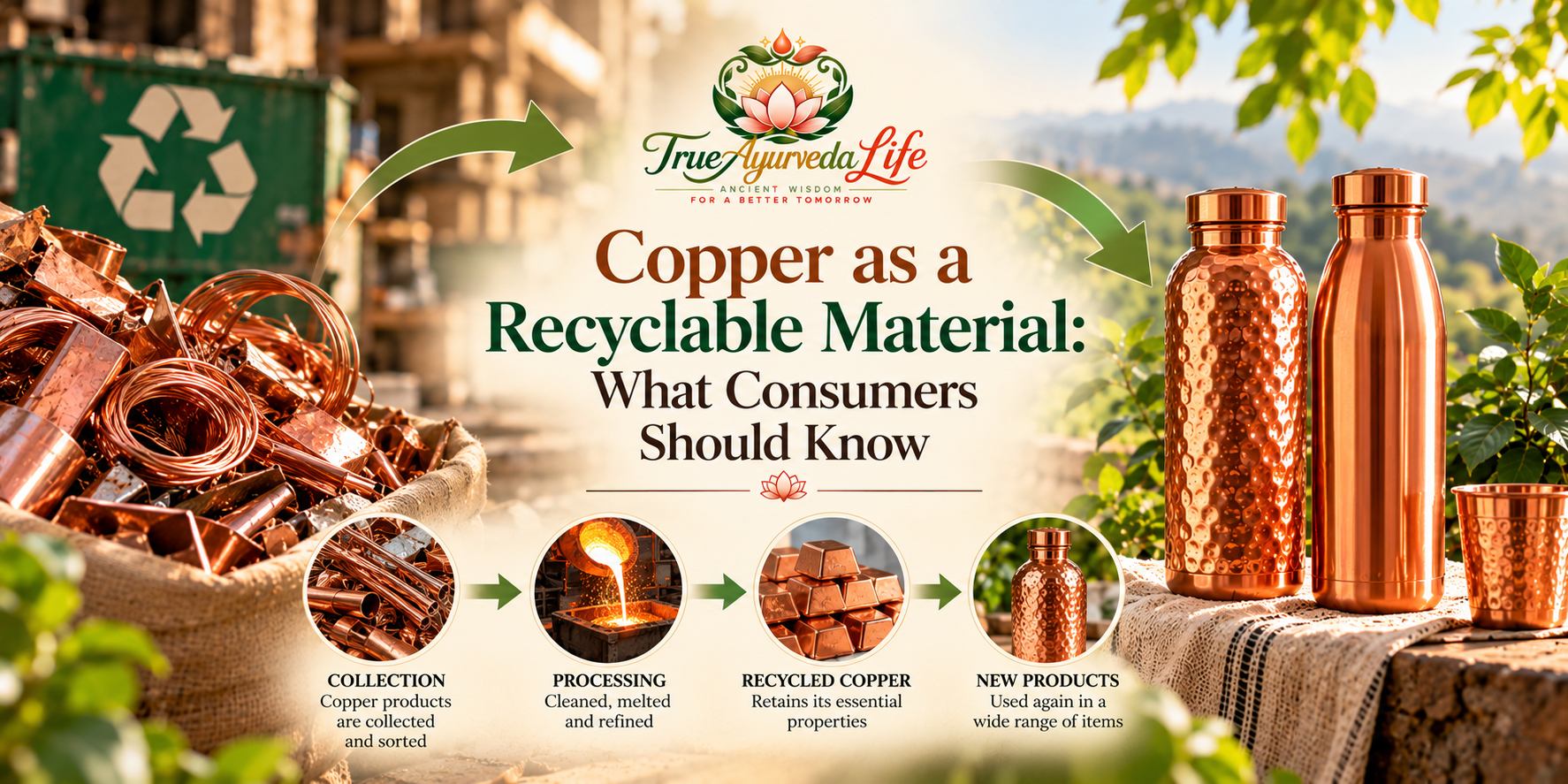
Copper has been used for centuries to make household vessels, tools, decorative objects, electrical components, and everyday products. Its distinctive appearance makes it recognisable, but one of its most important material properties is less visible: copper can be recycled repeatedly without losing its essential properties.
As consumers become more interested in responsible purchasing and reducing waste, understanding recyclable materials has become increasingly relevant. A copper water bottle, tumbler, or household vessel can have a useful life beyond its original purpose, provided the product is collected and processed through suitable recycling channels.
However, recyclability alone does not make every copper product environmentally friendly. The way copper is sourced, manufactured, used, maintained, and recovered also matters.
Here is what consumers should know about copper recycling and how it relates to everyday products.
1. Why Copper Is Considered Recyclable
Copper is a metal with properties that make it suitable for repeated recycling. Unlike materials that may lose some performance characteristics through certain recycling processes, copper can retain its essential properties through successive cycles of melting and refining.
Recovered copper can be processed and used to manufacture a wide range of products, including electrical wiring, plumbing components, industrial equipment, and metal goods.
This ability to remain useful makes copper valuable within a circular economy. Instead of treating a metal product as waste once it is no longer needed, its material can potentially return to manufacturing.
According to the International Copper Association, recycling plays an important role in copper's life cycle and can reduce the need for newly mined material.
Consumers can learn more in the association's overview of the copper life cycle and recycling.
The important distinction is that recyclable does not mean automatically recycled. A product must reach a collection and processing system capable of recovering its material.
2. How Copper Recycling Works
Copper recycling generally involves several stages. The exact process depends on the type of scrap, its purity, the presence of other materials, and the facilities handling it.
Collection
Copper-containing products are collected from households, businesses, construction projects, manufacturing operations, and scrap dealers.
Items may include pipes, electrical cables, metal fittings, cookware, and other copper goods.
Sorting and preparation
The collected material is sorted according to its composition and condition. Copper scrap can vary considerably in purity, and separating it from other metals or non-metal components helps determine how it can be processed.
A product with plastic, rubber, steel, solder, or coatings may require additional preparation.
Processing and refining
Depending on the material, copper scrap may be melted and refined or processed using other suitable methods. The objective is to recover copper that meets the requirements for its intended application.
Manufacturing again
Recovered copper can become part of new products. It may return to applications similar to its original use or enter a different manufacturing process.
This is one reason copper is valuable as a recyclable material: it can remain a useful resource rather than being discarded after one product's lifespan.
3. Does Recycled Copper Have the Same Quality?
Copper can be recycled repeatedly without losing its fundamental material properties. However, the quality of the recovered material depends on the scrap composition, contamination, sorting, and processing methods.
Clean, well-sorted copper scrap may be suitable for relatively direct recycling routes. Mixed or contaminated scrap may require more extensive treatment.
It is also important to distinguish between the recyclability of copper as a material and the quality of a finished product.
A well-made copper bottle depends on more than the metal itself. Its thickness, construction, joints, finish, lid, and intended use all affect how it performs.
Consumers should not assume that every product made from copper scrap is automatically identical in quality to a product made from newly refined copper. Suitable processing and manufacturing controls remain essential.
4. Why Recycling Copper Can Matter for the Environment
Mining and refining new copper require energy and natural resources. These activities can also affect land, water, and surrounding ecosystems, depending on how extraction and processing are managed.
Recycling can help reduce demand for newly mined material and may require less energy than producing copper from ore. The precise savings depend on the scrap type, collection and transport distances, processing technology, and comparison being made.
Recycling also helps retain the value of a material that has already been extracted and processed.
Still, recycling is only one part of a product's environmental impact. Manufacturing, packaging, transportation, cleaning, and the length of time a product remains in use all contribute to its overall footprint.
For consumers, a sensible approach is to choose useful products, maintain them properly, avoid unnecessary replacement, and support recovery of materials when items reach the end of their useful lives.
5. Are Copper Water Bottles Recyclable?
Copper water bottles and tumblers may be recyclable through suitable metal recovery channels, depending on their construction and local recycling facilities.
A bottle made primarily from copper may be accepted by a scrap-metal dealer or metal recycling facility. However, products containing mixed materials may require separation before the copper can be recovered.
For example, a bottle might include a non-copper lid, plastic seal, coating, decorative components, or other metal parts. These details can affect how the item should be handled.
Before disposing of a copper bottle, consider the following:
Check whether the product can still be used safely.
If it is damaged, determine whether repair is practical.
Ask a local scrap-metal dealer or recycling facility whether it accepts the item.
Follow instructions for separating removable components where appropriate.
Do not assume that placing a copper item in an ordinary household recycling bin is suitable everywhere.
Local collection systems differ, so checking with the facility is more reliable than relying on a general recycling symbol or assumption.
6. How Long-Term Use Supports Responsible Consumption
Recycling is valuable, but keeping a suitable product in use can also be important.
Every new product requires materials, manufacturing, packaging, and transportation. Replacing an item unnecessarily can repeat those impacts before the original product has delivered much useful service.
A durable, well-maintained bottle may remain part of a person's routine for years. The benefit depends on its actual lifespan and use, rather than the material alone.
A few simple habits can help:
Choose a bottle that suits your daily needs.
Read the care instructions before cleaning it.
Store it appropriately and avoid damaging the lid or joints.
Replace worn components when safe and practical.
Avoid buying replacements simply because a new design becomes fashionable.
This approach applies to copper, stainless steel, glass, and other reusable materials. The best product is one that meets your needs and remains useful for as long as practical.
7. What Consumers Should Check Before Buying Copper Products
Recyclability is one consideration when choosing a product, but it should not be the only one.
Understand the material
Look for clear product information describing whether the item is made from copper, copper-plated material, or a combination of different materials.
The distinction matters because a copper-plated product contains a different amount and arrangement of copper from a product made primarily of copper.
Check construction and intended use
Review details about the bottle's material, joints, lid, lining, and recommended beverages. An ordinary copper water bottle should be used according to the manufacturer's instructions.
Look for credible environmental information
If a seller claims that a product contains recycled copper, ask whether that claim is supported by clear documentation. Do not assume a product uses recycled material simply because copper is recyclable.
Consider the product's lifespan
A suitable, well-constructed item that you will use regularly may be a more thoughtful purchase than one selected only for appearance or a short-lived trend.
These checks help consumers make informed decisions without relying on broad environmental claims.
8. Copper Craftsmanship and the Value of Materials
Copper has a significant place in India's metalworking traditions. Across different regions, artisans have shaped, hammered, engraved, and finished copper and other metals into vessels and decorative objects.
These traditions demonstrate how raw material can be transformed through knowledge, skill, and careful workmanship.
Modern copper drinkware continues this connection between material and craft. A handcrafted bottle may feature a hammered surface, a distinctive shape, or finishing details that reflect the production process.
However, handmade production is not automatically sustainable, just as industrial production is not automatically wasteful. Environmental impact depends on the actual materials, processes, product lifespan, and recovery options.
To learn more about the cultural side of this material, read our article on why copper has remained part of Indian craftsmanship.
Understanding the story behind a product can help consumers appreciate its design while still asking practical questions about quality and responsible production.
9. Copper Recycling and the Circular Economy
A circular economy aims to keep materials and products useful for as long as practical through maintenance, reuse, repair, refurbishment, and recycling.
Copper is well suited to this idea because it can be recovered and returned to manufacturing. Yet an effective circular system requires more than a recyclable material.
Products need to be collected. Their materials need to be identified and separated. Recycling facilities must have suitable processing capabilities, and recovered material needs a route back into manufacturing.
Consumers can contribute by maintaining products, avoiding unnecessary disposal, and using appropriate recycling channels.
Businesses also have a role to play by providing accurate material information, designing products with recovery in mind, and communicating clearly about the environmental characteristics they can substantiate.
No single action solves the entire waste problem, but thoughtful decisions at different stages can help keep useful materials in circulation.
A Material With More Than One Life
Copper's ability to be recycled repeatedly gives it an important place in conversations about resource use and responsible consumption. From industrial components to traditional household vessels and modern drinkware, recovered copper can continue to serve useful purposes.
But the real value of recyclability depends on what happens in practice. Products must be maintained, collected, sorted, and processed appropriately. Their environmental impact also depends on how they are manufactured and how long they remain in use.
For consumers, the lesson is simple: understand what you are buying, use it thoughtfully, and find an appropriate recovery route when it is no longer useful.
At TrueAyurvedaLife, we appreciate copper not only for its traditional place in Indian households but also for its distinctive material qualities and enduring craftsmanship. By combining informed purchasing with long-term use and responsible recycling, consumers can make more considered choices about the objects they bring into everyday life.